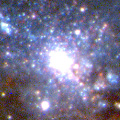
Close-Up of Star Formation in Antennae Galaxy

The collision triggers the birth of new stars in brilliant blue star clusters, the brightest of which contains roughly a million stars. The star clusters are blue because they are very young, the youngest being only a few million years old, a mere blink of the eye on the astronomical time scale.
Credit:About the Image
About the Object
| Name: | Antennae, IRAS 11593-1835, NGC 4038, NGC 4039 |
| Type: | Local Universe : Galaxy : Type : Interacting |
| Distance: | 35 million light years |
| Constellation: | Corvus |
| Category: | Galaxies |


Coordinates
| Position (RA): | 12 1 50.42 |
| Position (Dec): | -18° 52' 11.51" |
| Field of view: | 0.10 x 0.10 arcminutes |
| Orientation: | North is 119.8° left of vertical |
View in ESASky:
View in WorldWide Telescope:

Colours & filters
| Band | Wavelength | Telescope |
|---|---|---|
| Ultraviolet U | 336 nm |
Hubble Space Telescope
WFPC2 |
| Optical B | 439 nm |
Hubble Space Telescope
WFPC2 |
| Optical V | 555 nm |
Hubble Space Telescope
WFPC2 |
| Infrared I | 814 nm |
Hubble Space Telescope
WFPC2 |