Planetary Nebula NGC 3918
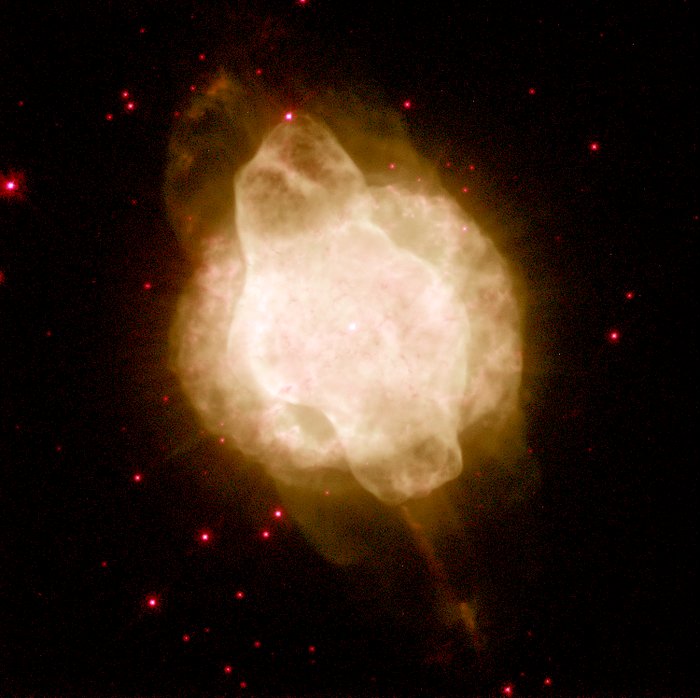
Studying images of proto-planetary nebulae is important to understanding the process of star death. A star begins to die when it has exhausted its thermonuclear fuel - hydrogen and helium. The star then becomes bright and cool (red giant phase) and swells to several tens of times its normal size. It begins puffing thin shells of gas off into space. These shells become the star's cocoon. In the Hubble images, the shells are the concentric rings seen around each nebula.
Credit:About the Image
About the Object
| Name: | IRAS 11478-5654, NGC 3918 |
| Type: | Milky Way : Nebula : Type : Planetary |
| Distance: | 5000 light years |
| Constellation: | Centaurus |
| Category: | Nebulae |


Coordinates
| Position (RA): | 11 50 17.89 |
| Position (Dec): | -57° 10' 56.64" |
| Field of view: | 0.57 x 0.57 arcminutes |
| Orientation: | North is 101.9° left of vertical |
View in ESASky:

View in WorldWide Telescope:

Colours & filters
| Band | Wavelength | Telescope |
|---|---|---|
| Optical V | 555 nm |
Hubble Space Telescope
WFPC2 |
| Infrared I | 814 nm |
Hubble Space Telescope
WFPC2 |