Hubble's instruments: ACS - Advanced Camera for Surveys
The Advanced Camera for Surveys (ACS) replaced Hubble's Faint Object Camera during Servicing Mission 3B. Its wavelength range extends from the ultraviolet, through the visible and out to the near-infrared. ACS is a so-called third generation Hubble instrument. Its wide field of view is nearly twice that of Hubble's former workhorse camera, WFPC2, and with its superb image quality and high sensitivity, ACS has increased Hubble's potential for new discoveries by a factor of ten. The name, Advanced Camera for Surveys, comes from its particular ability to map large areas of the sky in great detail. ACS can also perform spectroscopy with a special optical tool called a 'grism'.
Three sub-instruments make up ACS
The Wide Field Channel is a high efficiency, wide field, optical and near-infrared camera. This space eye is optimised to hunt for galaxies and galaxy clusters in the remote and ancient Universe, at a time when our Cosmos was very young. The distribution in space of these distant objects will enable scientists to investigate just how the Universe evolved.
Another sub-instrument is the High Resolution Channel, though this is not currently operational. This camera was designed to take extremely detailed pictures (high resolution) of the light from the centres of galaxies with massive black holes, as well as of ordinary galaxies, star clusters and gaseous nebulae, where extraterrestrial planetary systems may be hidden. The instrument includes a coronograph, capable of improving Hubble's contrast near bright objects by about a factor of 10.
Finally, the Solar Blind Channel blocks visible light to allow faint ultraviolet radiation to be discerned. Among other things, it can be used to study weather patterns on other planets and aurorae on Jupiter.
ACS Facts |
|
| Instrument type | Camera |
| Field of view |
202 x 202 arcseconds (Wide Field Channel) 29.1 x 26.1 arcseconds (High Resolution Channel) 34.59 x 30.8 arcseconds (Solar Blind Channel) |
| Detector array size |
4096 x 4096 (WFC) 1024 x 1024 (HRC) 1024 x 1024 (SBC) |
| Wavelength range |
350-1050 nm (WFC) 200-1050 nm (HRC) 115-180 nm (SBC) |

Technicians working with the ACS instrument in a clean room environment.
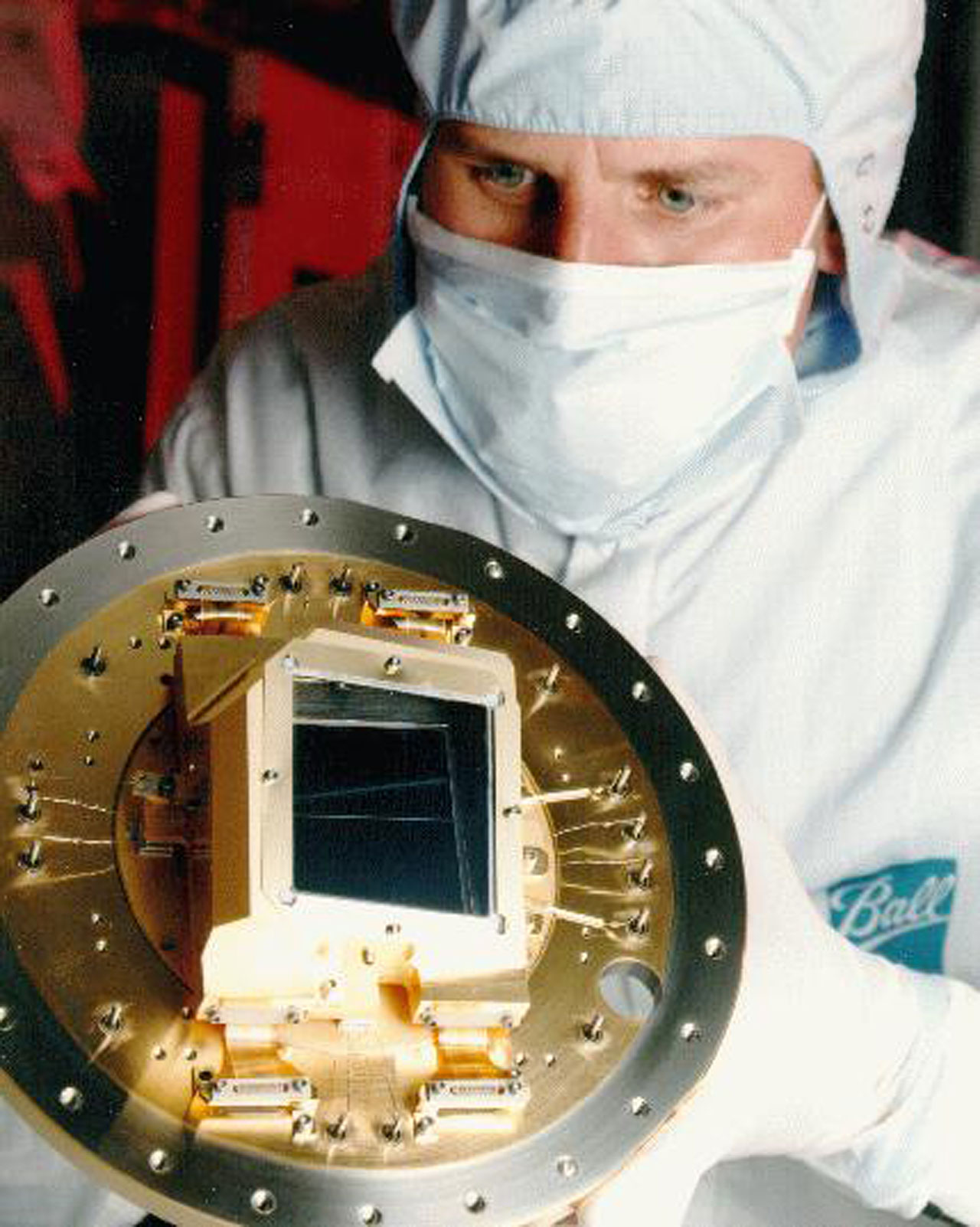
A look into one of ACS's most delicate and crucial parts - the CCD camera.
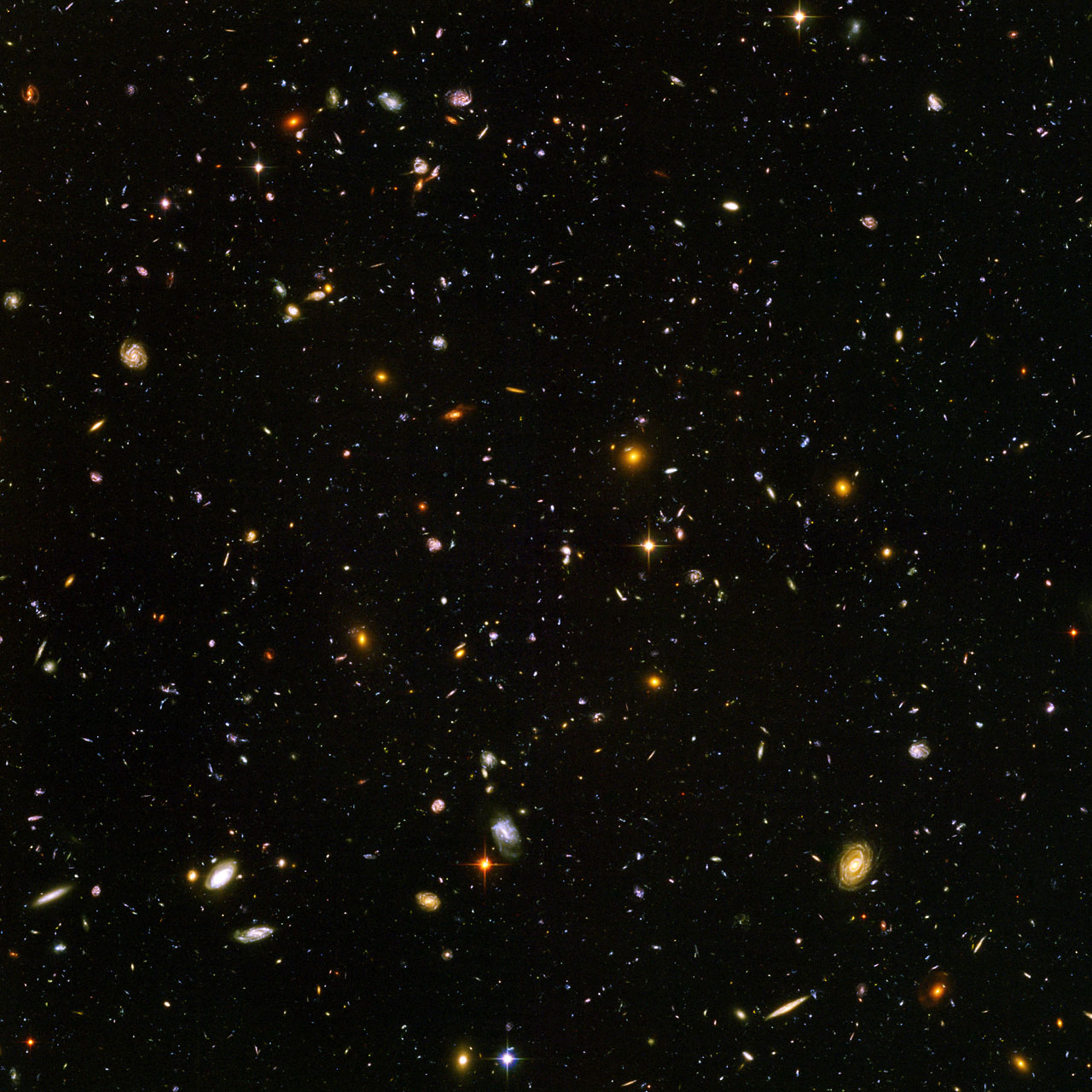
The Hubble Ultra Deep Field, the deepest ever optical image of the cosmos, imaged by ACS