Hubble's Instruments: FGS - Fine Guidance Sensors
The Fine Guidance Sensor (FGS) is an optical sensor used on the Hubble Space Telescope to provide pointing information for the spacecraft and as a scientific instrument for astrometric science.
A FGS consists of a large structure housing a collection of mirrors, lenses, servos, prisms, beam-splitters and photomultiplier tubes.
Hubble uses three fine guidance sensors located around the circumference of the telescope. Two FGSs point the telescope at targets and hold that target in the scientific instrument's field of view. The third FGS is then used as a scientific instrument for astrometry. Typically, the best FGS is used for this purpose – which means the newest.
Pointing Control
The fine guidance sensors are one type of sensor used by Hubble’s pointing control system to aim the telescope at a target with an accuracy of 0.01 arcsecond.
The FGS detects when the telescope drifts even a miniscule amount and returns the spacecraft to its target. Hubble has the ability to remain pointed at that target with no more than 0.007 arcseconds deviation over a day.
Astrometry Science
Astrometry is the science of determining the precise positions and motions of stars. The FGS can determine the positions of stars to a precision 10 times greater than ground based observatories. When used for astrometric science the fine guidance sensors will let Hubble:
- Search for a wobble in the motion of nearby stars, possibly indicating the presence of a planetary companion
- Determine if certain stars are double stars
- Measure the angular diameter of stars, galaxies and other celestial objects
- Refine the positions, distances and energy output of stars
- Help determine the true distance scale for the Universe
Links
Fact Sheet (PDF file)
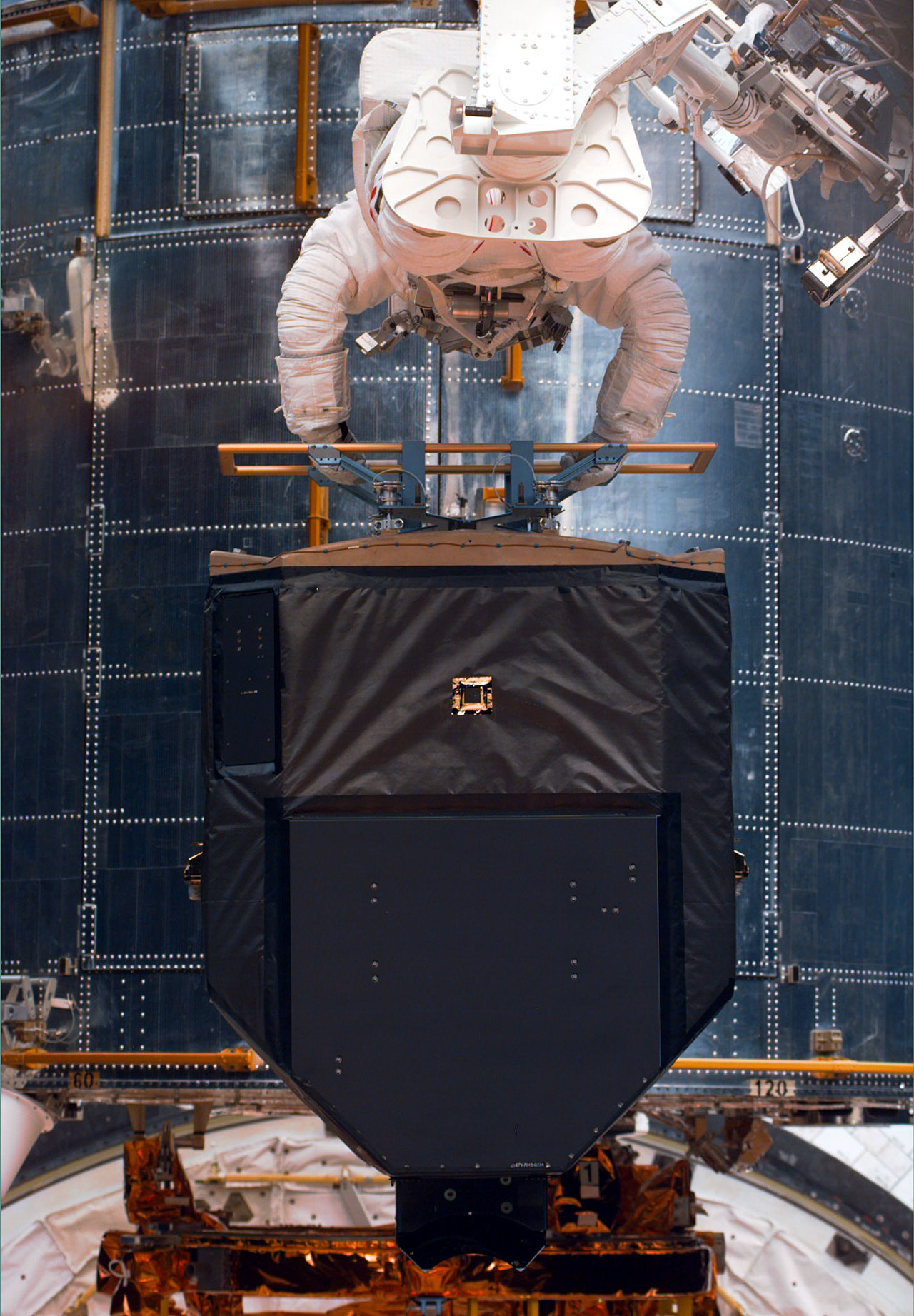
One of the three Fine Guidance Sensors photographed during Second Servicing Mission in 1997. |