NICMOS returns
|
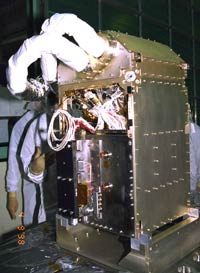
During Servicing Mission 3B, astronomers all over the world eagerly anticipated the return of NICMOS (the Near Infrared Camera and Multi-Object Spectrometer), the sharpest definition infrared instrument in existence at the time, after more than two years of enforced rest. NICMOS was originally installed onboard Hubble during the second Servicing Mission (SM2) in February 1997. Unfortunately NICMOS' lifetime was reduced from the expected 4.5 years to about 2, due to a problem in the cooling system. The sides of the thermos flask touched and as a result the solid nitrogen inside heated up and evaporated, meaning that by January 1999 all the coolant had evaporated and NICMOS could no longer operate. Once the problem was recognised the Space Telescope scheduling was adjusted in such a way that NICMOS observations were assigned to as much as 40-50% of the total observing time during the first period of observations after the instrument was installed. In this way the NICMOS science programme was completed despite the instrument's dramatically shortened lifetime. During Servicing Mission 3B, NICMOS' enforced shutdown was ended. Astronauts retrofitted it with a new, experimental cooling system that returned it to active duty. By fitting NICMOS with a refrigerator-like cooling system, it was once again possible to re-cool the detectors to -196º C (77° K), thereby reawakening their infrared vision and extending the instrument's life by several years. The super-quiet cooler (called the NICMOS CryoCooler - NCC) uses ultra-high-speed microturbines, spinning up to more than 400,000 rpm (revolutions per minute) - over 100 times the revolutions of a typical car engine). Hubble's engineering team successfully demonstrated this technology in 1998 during another Shuttle mission in the first on-orbit test of this high-performance, high-efficiency, mechanical cryocooler. |
The very advanced Nicmos CryoCooler designed to cool Nicmos onboard Hubble. |