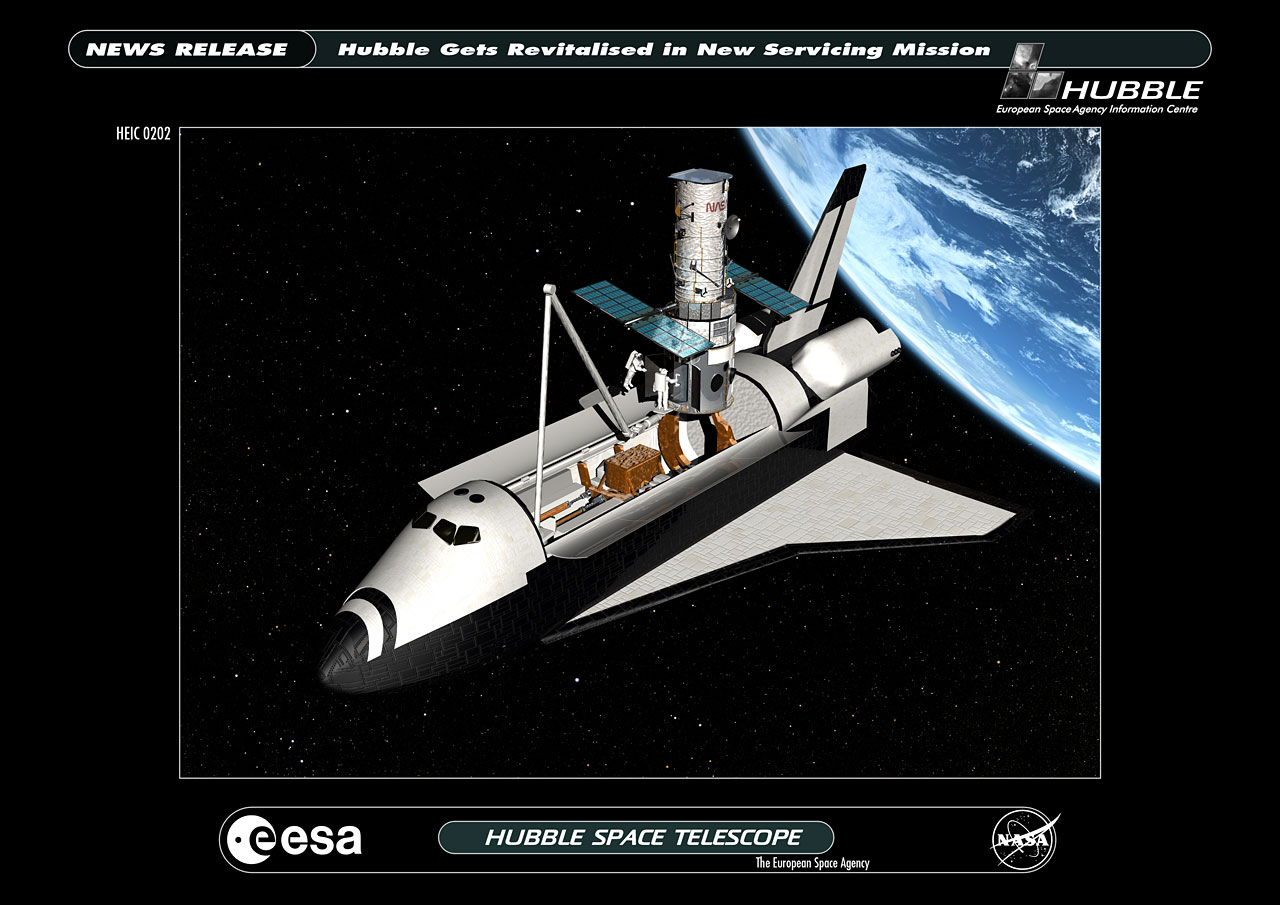
Hubble gets revitalised in new servicing mission

This is an artist's impression of how the very early universe (less than 1 thousand million years old) might have looked when it went through a voracious onset of star formation, converting primordial hydrogen into myriad stars at an unprecedented rate. Back then the sky would have looked markedly different from the sea of quiescent galaxies around us today. The sky is ablaze with primeval starburst galaxies; giant elliptical and spiral galaxies have yet to form. Within the starburst galaxies, bright knots of hot blue stars come and go like bursting fireworks shells. Regions of new starbirth glow intensely red under a torrent of ultraviolet radiation. The most massive stars self-detonate as supernovas, which explode across the sky like a string of firecrackers. A foreground starburst galaxy at lower right is sculpted with hot bubbles from supernova explosions and torrential stellar winds. Unlike today there is very little dust in these galaxies, because the heavier elements have not yet been cooked up through nucleosynthesis in stars. Recent analysis of Hubble Space Telescope deep sky images supports the theory that the first stars in the universe appeared in an abrupt eruption of star formation, rather than at a gradual pace.

Credit:

About the Image

Id:heic0202a
Release date:Feb 15, 2002, 15:00 CET
Related release:heic0202
Size:2508 x 1771 px

About the Object

Name:SM3B
Type:• Spacecraft Images/Videos
• Illustration Images
• Mission

Images

Large JPEG
1.2 MB
Screensize JPEG
225.3 KB

Print Layout

Screensize JPEG
173.3 KB

Wallpapers

1024x768
277.4 KB
1280x1024
440.3 KB
1600x1200
619.4 KB

Also see our