heic0506 — Science Release
Hubble celebrates 15th anniversary with spectacular new images
25 April 2005

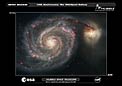
During the 15 years that the NASA/ESA Hubble Space Telescope has orbited the Earth, it has taken three-quarters of a million photos of the cosmos - images that have awed, astounded and even confounded astronomers and the public alike. Today NASA and ESA released new views of two of the most well-known images Hubble has ever taken: the Eagle Nebula, and spiral galaxy M51, known as the Whirlpool Galaxy.
The new images released today are among the largest and sharpest views Hubble has ever taken, were made with Hubble's Advanced Camera for Surveys (ACS). The two new images are so incredibly sharp they could be enlarged to billboard size and still retain all of their stunning details.
For Hubble's 15th anniversary, scientists used the newer ACS camera to revisit one region of the eerie-looking Eagle Nebula, producing a new image with stunning detail. The new Eagle Nebula image reveals a tall, dense tower of gas being sculpted by ultraviolet light from a group of massive, hot stars. The new Whirlpool Galaxy image showcases the spiral galaxy's classic features, from its curving arms, where newborn stars reside, to its yellowish central core that serves as home for older stars.
NASA's Space Shuttle Discovery launched Hubble into space on 24 April 1990 and placed it into orbit a day after, thereby opening a brand new era in astronomy. For the first time ever, a large telescope that viewed in visible light orbited above Earth's distorting atmosphere, which blurs starlight making images appear fuzzy. After installation of a new camera and a device that compensated for an improperly ground mirror, images of planets, stars, galaxies, and nebula began pouring in - all up to 10 times sharper than any previous telescope had ever delivered.
Scientists using Hubble have compiled a long list of scientific achievements since its launch 15 years ago. Hubble has:
- Helped astronomers calculate the precise age of the universe (13.7 billion years old);
- Helped confirm the existence of a strange form of energy called dark energy;
- Detected small proto-galaxies that emitted their light when the universe was less than a billion years old;
- Proved the existence of super-massive black holes;
- Provided sharp views of a comet hitting Jupiter;
- Showed that the process of forming planetary systems is common throughout the galaxy, and;
- Taken more than 700,000 snapshots of celestial objects such as galaxies, dying stars, and giant gas clouds where stars are born.
To mark the event on 24 April, the European Space Agency is presenting a series of unique activities in collaboration with partners all over Europe. These includes an exclusive, full-length DVD film (one of the most widely distributed documentary films ever), a CD of the film soundtrack, a full-colour book and additional educational material. All over Europe, there will be Hubble Day events, press events and planetarium shows about Hubble. The mural-sized celestial images of the new Eagle Nebula and Whirlpool Galaxy were unveiled Sunday at the 40 Hubble Day events in Europe, as well as at more than 100 other venues in the USA.
Read more about the Hubble 15th Anniversary celebrations at the ESA Hubble 15th Anniversary web site: http://www.spacetelescope.org/projects/anniversary/
Notes
The videos to the right are from ESA's Anniversary movie Hubble - 15 Years of Discovery.
The Hubble Space Telescope is a project of international cooperation between ESA and NASA.
Some Hubble Facts:
- In its 15 years of viewing the sky, NASA's Hubble Space Telescope has taken more than 700,000 exposures and probed more than 22,000 celestial objects.
- The Hubble Ultra Deep Field (HUDF) is the most observed area of the sky. Hubble spent more than 500 hours viewing the HUDF, snapping more than 1,100 photographs.
- Hubble has whirled around Earth nearly 88,000 times, racking up more than 4 billion kilometres.
- The telescope's observations have produced 23 terabytes of data, equal to the amount of text in 23 million novels.
- Each day the orbiting observatory generates enough data - about 15 gigabytes - to fill more than three DVDs.
- In Hubble's 15-year lifetime, about 3,900 astronomers from all over the world have used the telescope to probe the universe.
- Astronomers have published more than 4,000 scientific papers on Hubble results.
Image credit heic0506a: NASA, ESA, S. Beckwith (STScI), and The Hubble Heritage Team (STScI/AURA).
Image credit heic0506b: NASA, ESA, and The Hubble Heritage Team (STScI/AURA)
Links
- The ESA Hubble 15th Anniversary web site
- A list of Hubble Day venues in Europe
- Hubble Scientific successes
- A list of Hubble Day venues in the USA
- NASA's News Release
Contacts
Lars Lindberg ChristensenHubble European Space Agency Information Centre, Garching, Germany
Tel: +49-(0)89-3200-6306
Cellular: +49-(0)173-3872-621
E-mail: lars@eso.org
Bob Fosbury
Tel: +49-(0)89-3200-6291
E-mail: rfosbury@eso.org
Donna Weaver
Space Telescope Science Institute, Baltimore, MD, USA
Tel: +1-410/338-4493
About the Release
| Release No.: | heic0506 |
Images


Videos