The formation of stars
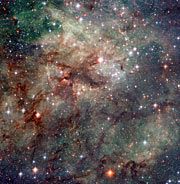 |
| This Hubble image shows part of the Tarantula, the brightest star-forming region in the local Universe. This nebula is found in the Large Magellanic Cloud, a companion galaxy of the Milky Way. |
To astronomers and laymen alike the topic of star formation has always been a particularly appealing one. The reason being that important clues about our genesis lie hidden behind the veil of the dusty, and often very beautiful, star forming molecular clouds. Our Earth and the Solar System were born 4.6 billion years ago and our knowledge of the event is sparse. Astronomers turn their eyes to the birth of other stars and stellar systems in neighbouring stellar ‘maternity wards’ and use these as a time machine to see a replay of the events that created our own Solar System.
Star forming regions also feature in some of the most attractive images Hubble has made.
Inside the Orion Nebula
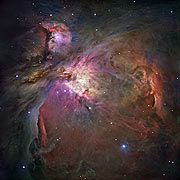 |
| The Orion Nebula is a region of star formation in the Milky Way. Hubble images have revealed "proplyds", discs of dust around newly born stars that are thought to be planetary systems in the early phases of their creation |
The large mosaic of 15 Hubble images showing the central part of the Orion complex is one of the most detailed images of a star forming region ever made. It shows a very young star cluster blowing a ‘bubble’ in its remnant parent cloud of glowing gas so that the stars start to be seen in visible light – like the smoke in a forest fire being driven away by the heat.
Hubble’s high resolution has been crucial in the investigation of the dust disks, dubbed proplyds, around the newly born stars in the Orion Nebula. The ‘proplyds’ may very well be young planetary systems in the early phases of their creation. The details that are revealed are better than what has been achieved with ground-based instruments, and thanks to Hubble we have today visual proof that dusty disks around young stars are common.
Peering through dust
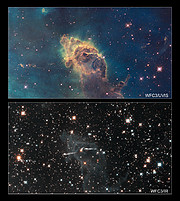 |
| Above, the Carina Nebula imaged in visible light by WFC3. Below, the same area imaged in infrared, revealing the stars hidden by the dusty clouds. |
Star birth always seems to take place in dusty environments, where Hubble’s infrared capabilities have been necessary. Dust clouds scatter visible light, but let infrared light through unimpeded, meaning infrared observations are often the only way to see young stars.
The upgrades installed on Hubble during the servicing mission in 2009 mean that Hubble’s is an extremely capable telescope for making infrared observations. The new Wide Field Camera 3 (WFC3) instrument is designed to make detailed images both in visible light and in infrared, and offers greatly improved capabilities in the infrared compared to what was possible before the servicing mission.
WFC3’s images of the Carina Nebula made in visible light show dense clouds of dust and gas. But the images taken by the camera of the same region in infrared make the dust fade, leaving just a faint outline of its location. The young stars forming inside the cloud are suddenly revealed. While the dust clouds make for very pretty pictures, they can often get in the way of what astronomers really want to see.
Star formation and the history of the cosmos
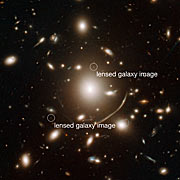 |
| Galaxy cluster Abell 383 is a gravitational lens. This process bends and amplifies the light from faraway galaxies, letting astronomers study star formation in galaxies that would normally be too distant and too faint to see. |
Hubble has also contributed to our understanding of star formation beyond the confines of the Milky Way. Neither Hubble nor any other telescope is able to see individual stars outside of the Milky Way and a handful of nearby galaxies in the so-called Local Group. However, the telescope has contributed to major discoveries about star formation in the far reaches of the Universe. This is important as faraway galaxies are seen far back in time, because of the huge distances their light has needed to reach us. Studying starlight from the most distant objects Hubble has observed gives clues about how stars formed in the early years of the Universe, and how they have changed over time.
This is not the realm of attractive Hubble images like those we save to our computer desktops — these objects can be too distant and too small to see clearly, and sometimes appear just as dots or small blobs in the images. Their unimpressive appearance does not mean they are impossible to study, however. Tricks such as spectroscopy (splitting light into its component colours) let scientists deduce many properties of the objects emitting the light, even if they can’t see them clearly. This is an important area of collaboration between Hubble and ground-based telescopes: while Hubble produces detailed images which help identify objects and their precise location in the sky, large telescopes on the ground are often in a better position to study their spectra.
Gravitational lensing (where the gravity of a galaxy cluster between us and the object being studied bends light beams towards us) is also part of astronomers’ arsenal as they study these faint and distant galaxies.
Hubble discoveries in the field of star formation in the early Universe include the realisation that stars and galaxies formed earlier in cosmic history than previously thought.
|
"Hubble has had a major impact in two areas in the field of star formation. Firstly it has studied the formation of stars like our Sun and has literally seen dusty disks which may end up as planetary systems around those stars. Secondly Hubble has made an impact in the area one could call ‘cosmological star formation’, that is, the formation of stars all over the Universe. Hubble Deep Field North for instance opened up the box and allowed us to follow the history of star formation through the entire Universe and in this way enabled us to study the ‘cosmic evolution’ of the stars." Hans Zinnecker |
Related images and videos
- Hubblecast episode 51: Star-forming region S 106
- Interview with Bob O’Dell, discoverer of proplyds in the Orion Nebula
- Hubblecast episode 32: Born in beauty – proplyds in the Orion Nebula
- Images of proplyds in Orion
- Images of star forming regions
Related news releases
- Unveiling the nature of a dusty galaxy (2000)
- Finding the ashes of the first stars (2003)
- Hubble panoramic view of the Orion Nebula reveals thousands of stars (2006)
- When it comes to galaxies, diversity is everywhere (2008)
- Hubble catches stars on the move (2010)
- First galaxies were born much earlier than expected (2011)
- Small but significant (2014)
- Hubble observes star reborn in a flash (2016)